The Complete Taxonomy of Intelligence: Unpacking the Differences Between AI, ML, DL, GenAI, LLMs, RAG, and Agentic AI
The Complete Taxonomy of Intelligence: Unpacking the Differences Between AI, ML, DL, GenAI, LLMs, RAG, and Agentic AI
The enterprise software landscape is saturated with artificial intelligence terminology. For technology leaders, architects, and developers, keeping these terms distinct is not just an academic exercise — it dictates architecture choices, budget allocations, infrastructure sizing, and governance models.
The Architectural Hierarchy: From Theory to Autonomous Action
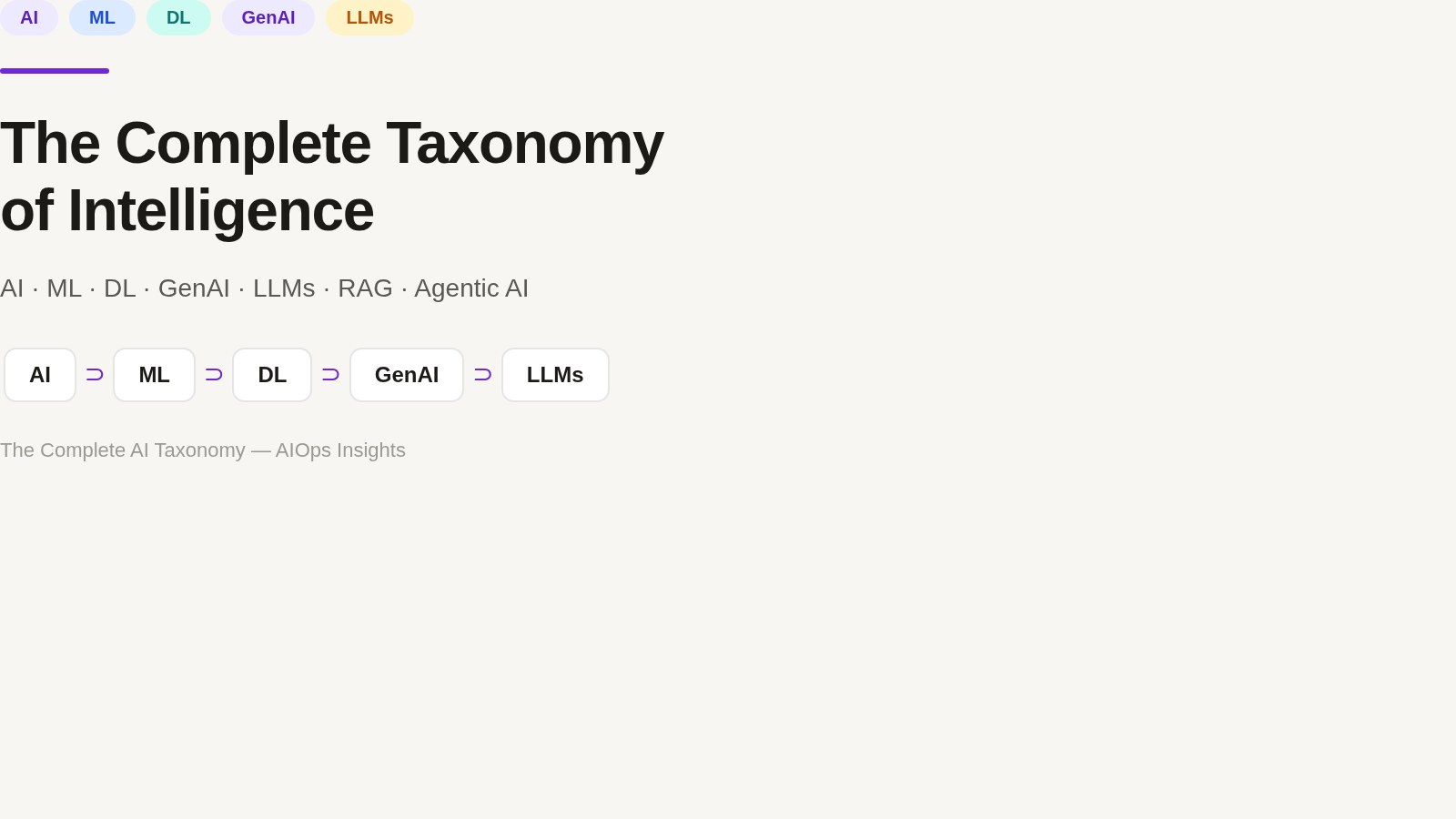
While marketing materials often treat AI, ML, DL, GenAI, LLMs, RAG, and Agentic AI as interchangeable buzzwords, they actually represent an evolutionary hierarchy: foundational mathematical theories, structural computing techniques, generative models, and autonomous operational frameworks.
To understand how these concepts interact, it is easiest to view them in two distinct groups:

Deep Dive: The Foundational Intelligence Stack
1. Artificial Intelligence (AI) — The Vision
Core Definition: The overarching discipline within computer science aimed at creating systems capable of performing tasks that typically require human cognition — decision-making, visual perception, speech recognition, and translation.
Mechanics: AI is not a single algorithm. It spans everything from deterministic rule-based engines (expert systems, search algorithms like A*) to dynamic statistical learning models.
Rule-based AI fails when confronted with edge cases that engineers have not explicitly pre-programmed.
2. Machine Learning (ML) — The Statistical Engine
Core Definition: A subset of AI where systems learn relationships, functions, and patterns directly from structured or unstructured data rather than following static, hand-coded rules.
Mechanics: Relies on statistical algorithms categorized into supervised learning (Linear Regression, Random Forests, XGBoost), unsupervised learning (K-Means Clustering, PCA), and reinforcement learning.
Traditional ML requires heavy feature engineering — human data scientists must manually extract, select, and clean domain-specific features for the model to perform.
3. Deep Learning (DL) — The Representation Engine
Core Definition: A specialized subfield of ML built on Artificial Neural Networks (ANNs) with three or more layers (deep architectures).
Mechanics: Employs multi-layered architectures — Convolutional Neural Networks for vision, Recurrent Neural Networks and Transformers for sequence modeling — that learn hierarchical representations automatically. Lower layers detect raw patterns (edges, phonemes); higher layers compose them into complex semantic concepts (faces, sentences).
Computationally expensive; requires specialized GPU acceleration and massive labeled datasets, operating largely as a "black box."
4. Generative AI (GenAI) — The Synthesis Shift
Core Definition: A category of Deep Learning architectures focused not on discriminating or classifying existing data ("Is this email spam?"), but on synthesizing entirely new, original artifacts that resemble the training distribution.
Mechanics: Leverages architectures such as Generative Adversarial Networks (GANs), Variational Autoencoders (VAEs), Diffusion Models (Stable Diffusion, Midjourney), and Autoregressive Transformers to generate text, audio, images, video, and synthetic code.
Susceptible to hallucination, mode collapse, and generating plausible-sounding falsehoods without an intrinsic understanding of physical reality.
5. Large Language Models (LLMs) — The Reasoning & Language Core
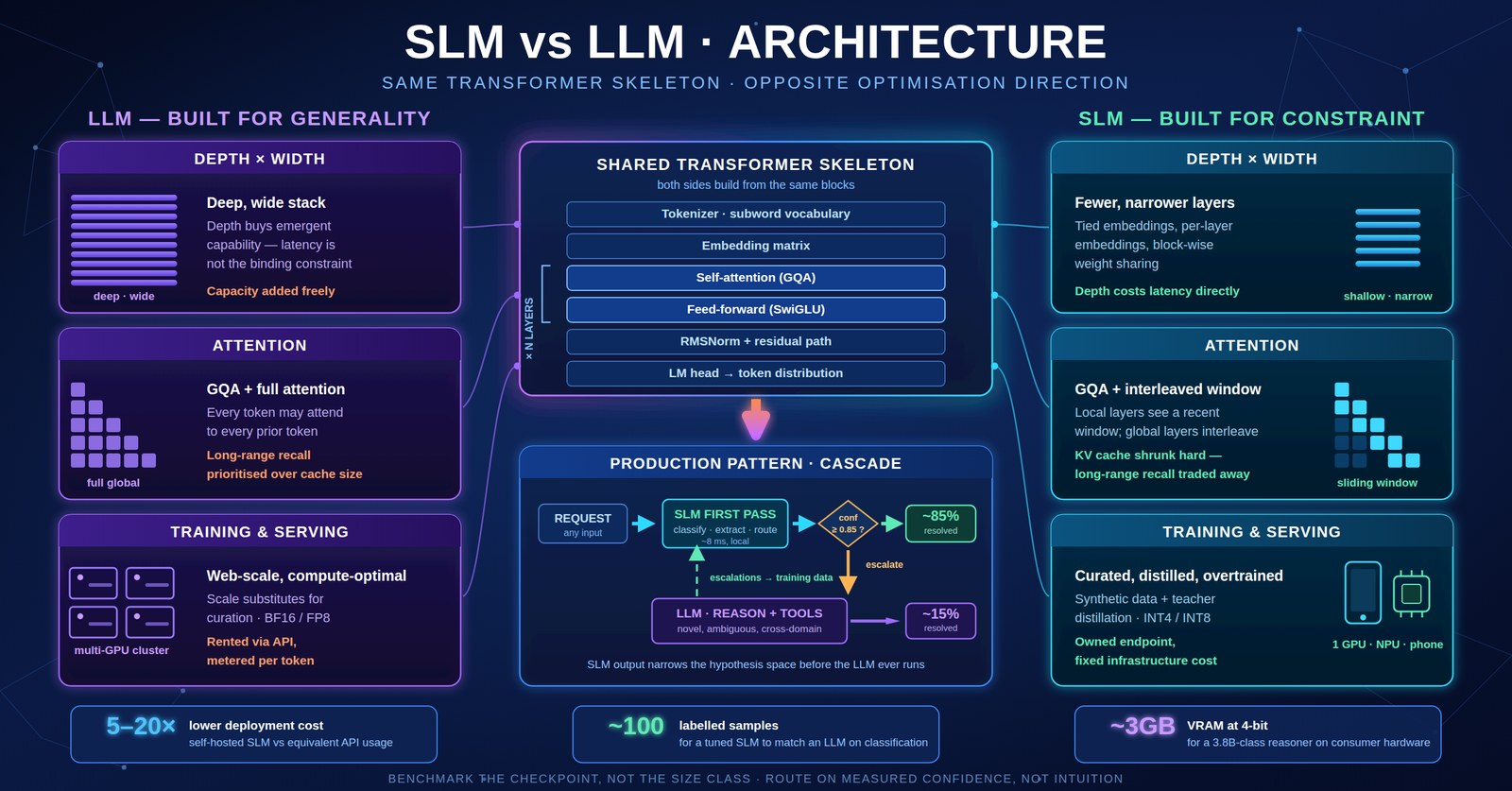
Core Definition: Massive, parameter-heavy GenAI models trained on web-scale textual corpora, designed to comprehend and generate human language and code.
Mechanics: Built primarily on the Transformer architecture utilizing self-attention mechanisms to weigh contextual relationships across long token sequences. LLMs function as autoregressive probability engines: given a prompt sequence, they predict the most statistically probable next token while modeling abstract reasoning chains.
Knowledge cutoffs, parametric memory limits, absence of real-time company data, and no native action-execution capability beyond text generation.
The Enterprise Augmentation Layer
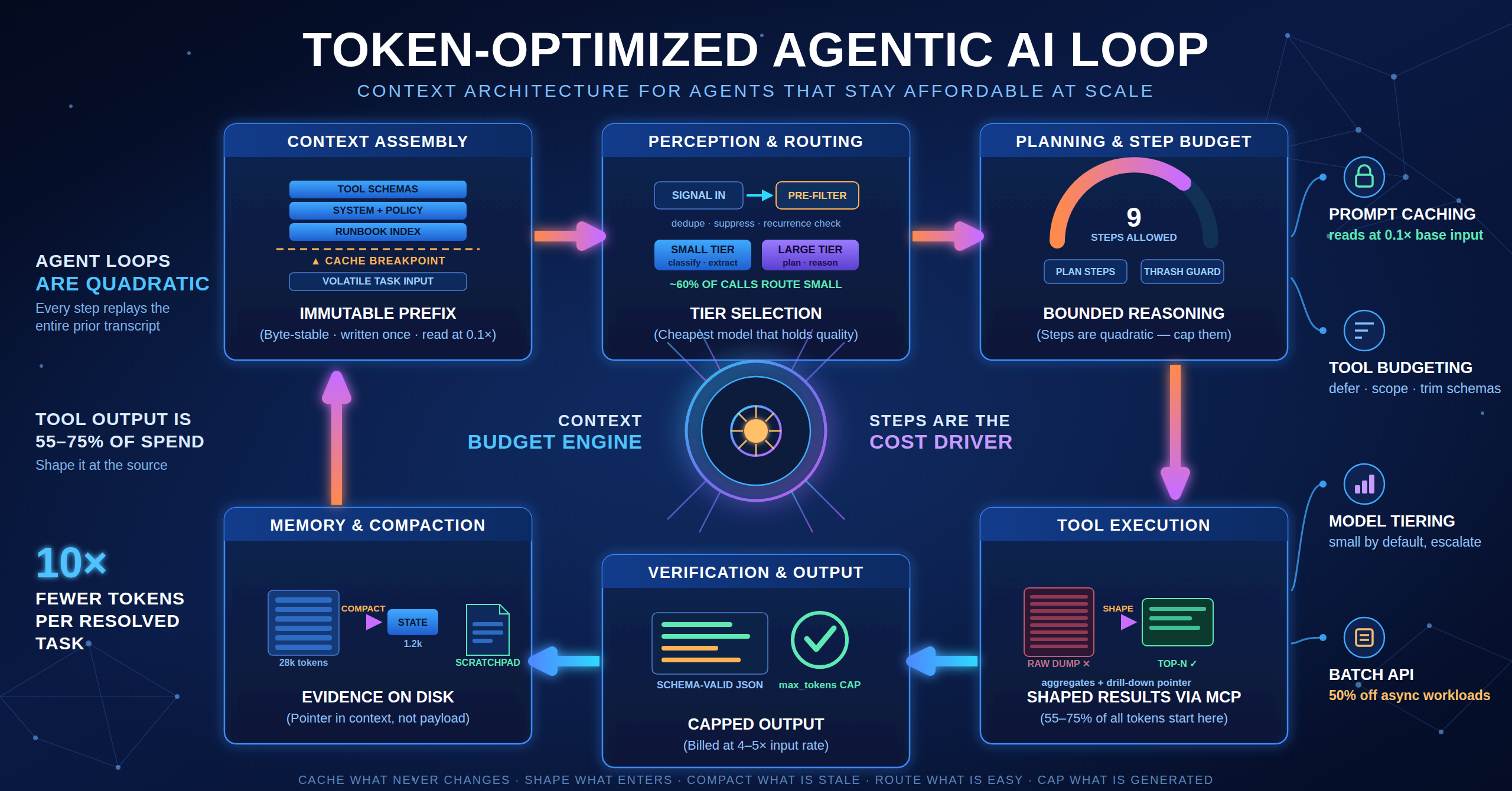
Raw LLMs are static mathematical models with frozen weights. To deploy them within enterprise workflows, organizations must augment them with memory (RAG) and execution capabilities (Agentic AI).
6. Retrieval-Augmented Generation (RAG) — The Memory Layer
Core Definition: An architectural pattern that dynamically retrieves relevant, non-parametric facts from an external knowledge repository and injects them into the LLM prompt context prior to generation.
How It Works:
- Ingestion: Enterprise documents (wikis, PDFs, databases) are split into chunks, converted into high-dimensional vector embeddings, and stored in a vector database (Pinecone, Qdrant, Azure AI Search).
- Retrieval: The user's query is converted into an embedding to run semantic/hybrid searches, retrieving the top-k most relevant document chunks.
- Generation: The retrieved chunks are concatenated with the original prompt, instructing the LLM to answer using only the provided context.
Solves data-freshness issues and hallucination without requiring multimillion-dollar model retraining or fine-tuning.
7. Agentic AI — The Operational Action Layer
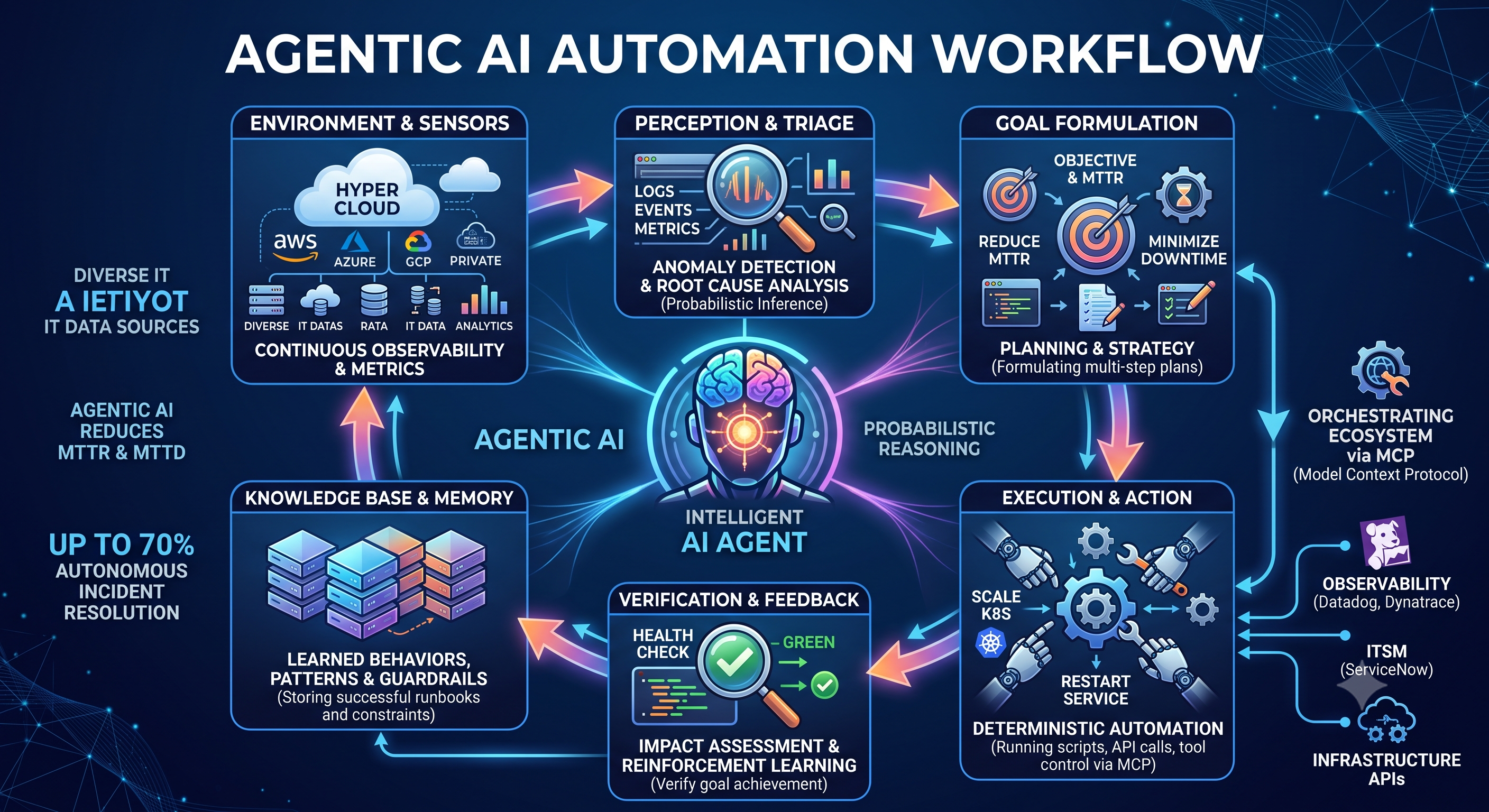
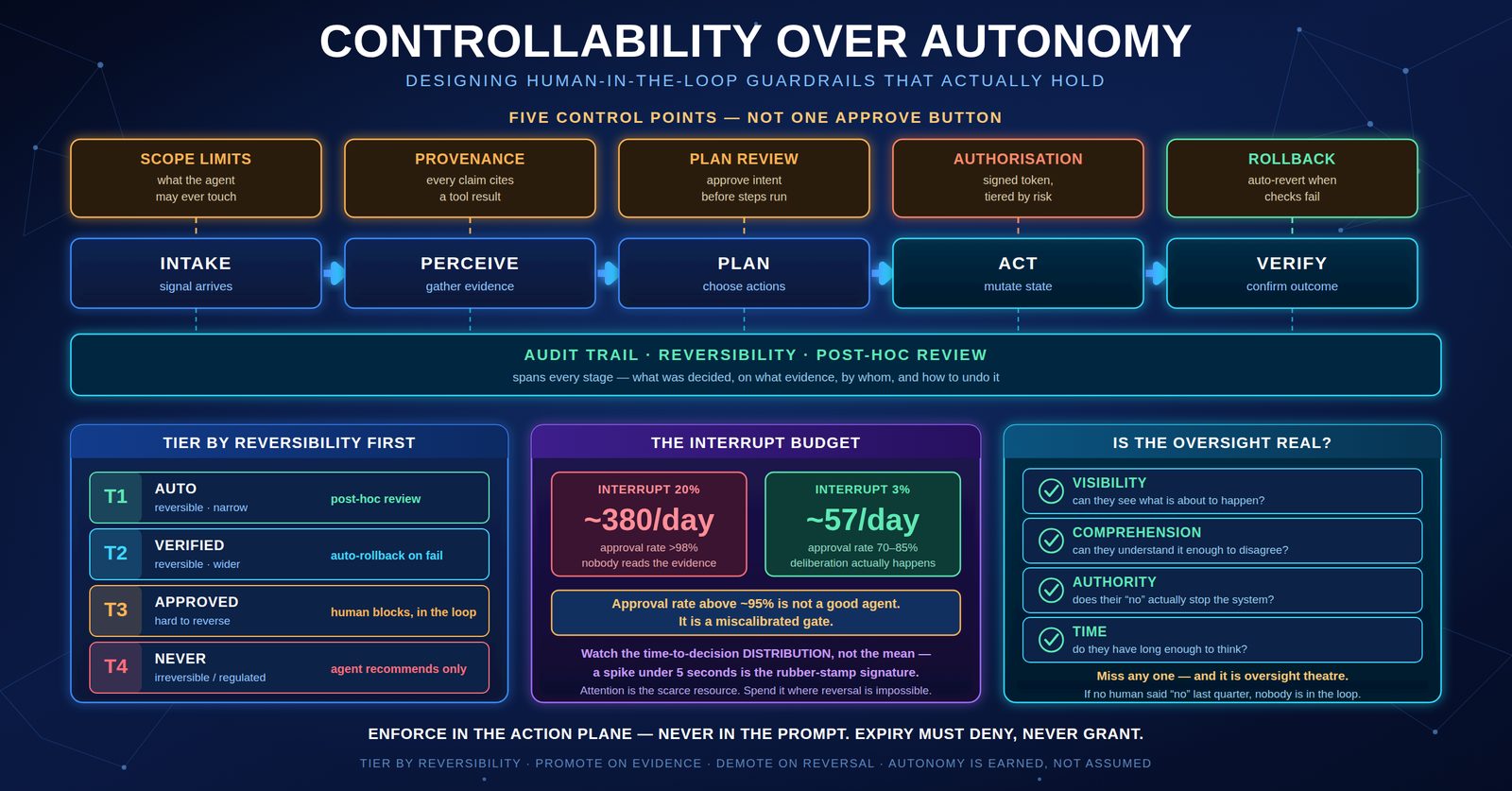
Core Definition: Autonomous systems where an LLM or SLM acts as a reasoning and planning engine capable of orchestrating multi-step workflows, invoking external APIs and tools, evaluating intermediate results, and self-correcting to achieve a specified goal.
How It Works:
- Perception: Ingests unstructured inputs, alerts, tickets, or environment states.
- Planning: Employs reasoning frameworks (ReAct, Plan-and-Solve, Tree of Thoughts) to break complex problems into sequential sub-tasks.
- Tool Execution: Interfaces with external systems via standardized protocols — Model Context Protocol (MCP), REST APIs, CLI runbooks.
- Verification Loop: Inspects tool responses; if a step fails or produces unexpected data, the agent adjusts its hypothesis and tries alternative routes until the goal is achieved or escalated.
Automates end-to-end operational workflows — autonomous incident remediation, proactive cloud security patching, multi-agent financial auditing.
Comprehensive Comparison Matrix
| Dimension | AI | ML | DL | GenAI | LLM | RAG | Agentic AI |
|---|---|---|---|---|---|---|---|
| Core Goal | Simulate cognition | Learn from data | Deep representations | Create novel artifacts | Language & reasoning | Ground in real-time facts | Execute autonomous goals |
| Input | Rules, logic, data | Structured tables, signals | Raw tensors (images, audio) | Prompts, latent noise | Token sequences | Query + knowledge bases | Goals + environmental states |
| Output | Decisions | Scores, clusters, predictions | Dense classifications, embeddings | Synthetic text, code, media | Contextual token streams | Fact-grounded generation | Workflows, API calls, state changes |
| Memory | Static / programmed | Parametric weights | Deep-layer weights | Generative latent distributions | Pre-trained weights | Dynamic external store | Dynamic scratchpad + shared state |
| Agency | None (passive) | None (predictive) | None (inference) | Low (single-turn) | Low (generation on invocation) | Low (context enrichment) | High (plan, call, execute) |
| Primary Risk | Inflexibility | Overfitting / bias | Opacity, compute cost | Hallucination | Stale data, nondeterminism | Retrieval mismatch | Infinite loops, action blast radius |
The Unified Architecture in Action
To see how all seven elements harmonize within a modern enterprise pipeline, consider an Autonomous IT Incident Management Platform: