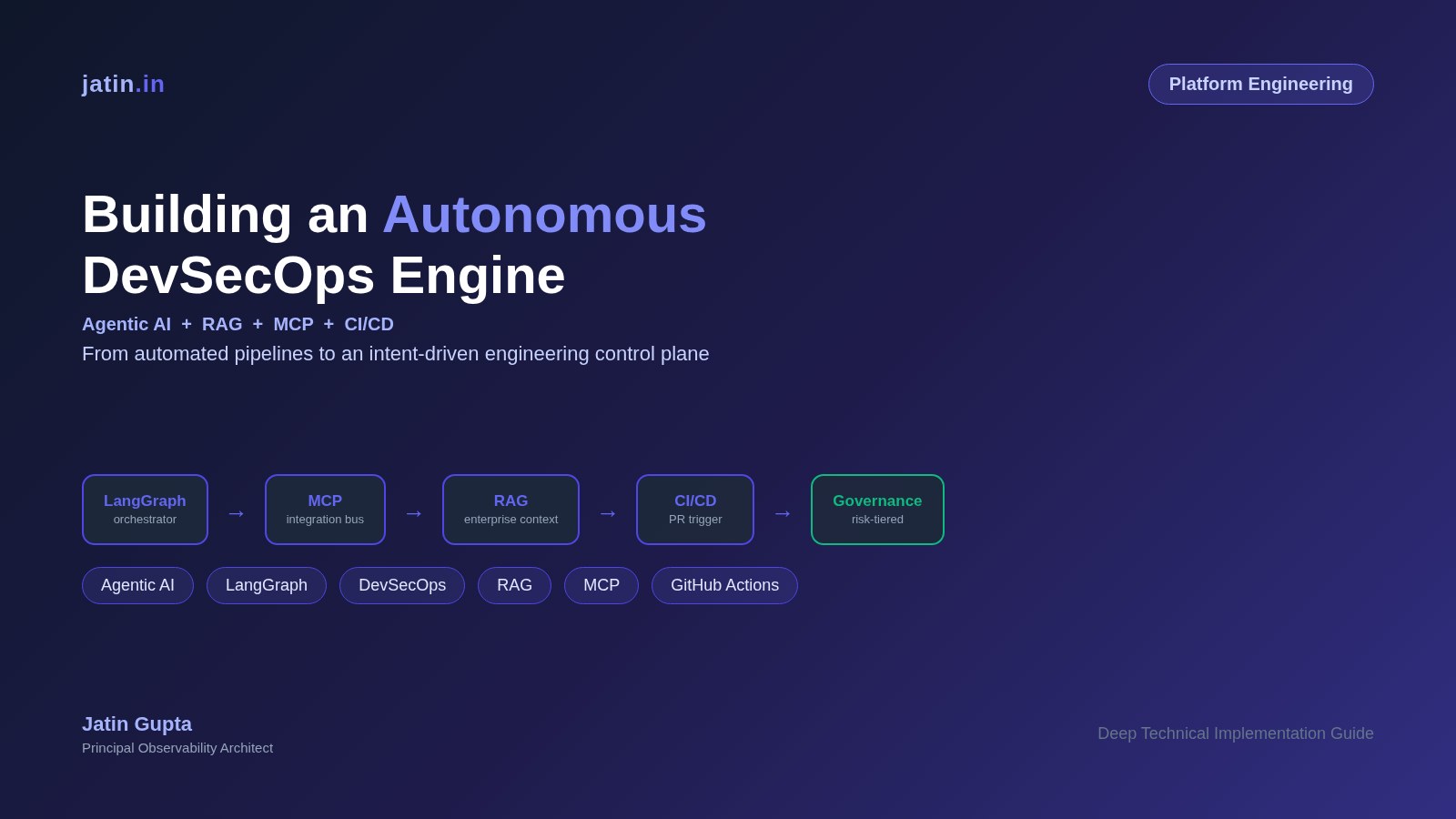
Building an Autonomous DevSecOps Engine (Agentic AI + RAG + MCP + CI/CD)
Building an Autonomous DevSecOps Engine
Agentic AI + RAG + MCP + CI/CD — the deep technical guide to moving from brittle, hand-wired security scripts to an intent-driven control plane that reviews, tests, and proposes fixes for infrastructure and application code.
From automated pipelines to autonomous engineering systems
The transition from automated pipelines to autonomous engineering systems requires a fundamental shift in architecture. You can no longer rely on brittle bash scripts piping output from one security tool to another. A script has a fixed shape: it runs the same commands in the same order and makes the same decisions regardless of what it finds. It cannot triage, cannot reason about severity, and cannot propose a fix.
Instead, you need a dynamic, intent-driven control plane. The system must observe a change, decide which checks matter, run them, interpret the results against your own policies, and act — autonomously where it is safe, escalating where it is not.
This guide details the technical implementation of combining Agentic AI, DevSecOps, RAG, MCP, and CI/CD into a single, cohesive engine that autonomously reviews, tests, and proposes fixes for infrastructure and application code.
The core execution engine: LangGraph
At the heart of this architecture is the AI Orchestrator. We use LangGraph to manage the execution flow, state, and decision-making of our multi-agent system. LangGraph allows us to define the DevSecOps process as a cyclical state machine rather than a linear script. Nodes are agent decisions; edges are transitions; cycles let the system re-plan when a check surfaces something unexpected.
The graph state must hold context references, PR metadata, and the accumulated findings of our specialized agents — Terraform, Kubernetes, Security, and the synthesizer that turns findings into a review.
The integration bus: Model Context Protocol (MCP)
A common anti-pattern is writing custom Python wrappers for every single DevSecOps tool — Trivy, Checkov, Kube-bench, each with its own CLI quirks and output formats. MCP (Model Context Protocol) eliminates this. It acts as the dependency injection layer for your agents, providing a standardized JSON-RPC interface to access external tools.
Your LangGraph nodes do not execute subprocess.run(["trivy", "fs", "."]). Instead, they declare a context requirement, and the MCP Client fetches it. The server executes the underlying binary securely and returns structured JSON findings back into the graph state.
When the terraform_agent node executes, the LLM requests a drift check or a terraform plan. The MCP server runs the binary, parses the output into structured JSON, and hands it back. The agent never shells out directly — every tool call is mediated, logged, and governed by the bus.
RAG injection: enforcing enterprise context
Generic AI will tell you that a public IP on a Kubernetes service is fine. RAG ensures the AI knows your company policy strictly forbids it. This is the difference between a clever assistant and a governance-compliant reviewer.
The RAG pipeline sits alongside the orchestrator. Before the synthesize_review node generates its final PR comment, it queries an internal vector database — Azure AI Search, Qdrant — containing your architecture decision records (ADRs), Confluence wikis, and security policies. The retrieved policy is injected into the context window, grounding every recommendation in your internal corporate governance.
Hybrid search matters here. Keyword matching catches exact policy titles ("no public IP on a service"); vector search catches semantic matches ("why is this load balancer exposed?"). Together they retrieve the right policy, and the retrieved policy is what constrains the agent's recommendation — not the model's generic training data.
CI/CD integration: GitHub Actions / Azure DevOps
The orchestrator must be triggered dynamically by the developer workflow. We containerize the LangGraph application and invoke it via a GitHub Action on every pull request — opened, synchronize, and reopened.
Notice the least-privilege posture baked into the workflow. OIDC replaces long-lived credentials; the runner holds only the permissions the review actually needs; the MCP servers run in an ephemeral, isolated network that cannot reach the production VPC.
Security & risk-tiered governance
Autonomy without boundaries is a critical vulnerability. We enforce a Risk-Tiered Approval Model directly within the LangGraph routing logic. The synthesize_review node assigns a risk_level — Low, Medium, High, Critical — based on the MCP tool findings and RAG policy violations. Then a conditional edge decides what happens to the PR.
Security guardrails to enforce
- ◆Network isolation. The MCP servers and the LangGraph container run in an ephemeral, isolated CI/CD runner network. They cannot reach the production VPC.
- ◆Secrets management. The AI does not have access to production secrets. If Terraform needs to plan against a live environment, it uses short-lived OIDC tokens retrieved dynamically by the CI/CD runner.
- ◆Auditability. Every tool invocation via MCP and every LLM API call is logged to a centralized SIEM (Splunk, Azure Sentinel) for full forensic traceability.
How the layers sit together
Assembled, the engine has a clear shape. GitHub Actions triggers the containerized orchestrator. LangGraph drives the state machine, running the three scan agents in parallel and synchronizing them into a synthesizer that grounds its review in RAG. The synthesizer assigns a risk tier, and governance routing decides the outcome — from auto-merge to hard block. Every step logs to the SIEM.
The complete stack, and why each layer earns its place
| Layer | Role | Adopt it when |
|---|---|---|
| LangGraph | Execution flow, state, decisions | You need durable, parallel, branching control flow — not a linear script |
| MCP | Standardized tool access | The fifth tool wrapper costs more than the first four combined |
| RAG | Enterprise policy enforcement | A generic answer is not enough; your policies must shape every review |
| GitHub Actions / Azure DevOps | Dynamic PR-driven trigger | You want review and testing on every push, not a manual gate |
| SIEM | Risk-tiered approval + audit | Autonomy requires boundaries and traceability from day one |
The whole point is not to surface more alerts — it is to reason about them. The engine filters out the noise, grounds its judgement in your policy, and writes the fix. That is the difference between a pipeline that reports and an engine that acts.
The pipeline stops being a pipeline and becomes a teammate
By mapping LangGraph's dynamic execution over MCP's standardized integration layer, and grounding the decisions in RAG, you build an engine that doesn't just surface alerts — it reasons about them, filters out the noise, and writes the fix. This is the blueprint for the next generation of platform engineering.
Start small: one scan agent behind an MCP server, one RAG index of your security policies, one conditional edge. Prove the loop on a low-risk repo. Then add the parallel agents, the risk tiers, and the auto-merge path. Autonomy is a capability you grow into, not a switch you flip.