CI/CD vs GitOps vs MLOps: The Three Pillars of Modern Software Delivery
CI/CD vs GitOps vs MLOps: The Three Pillars of Modern Software Delivery
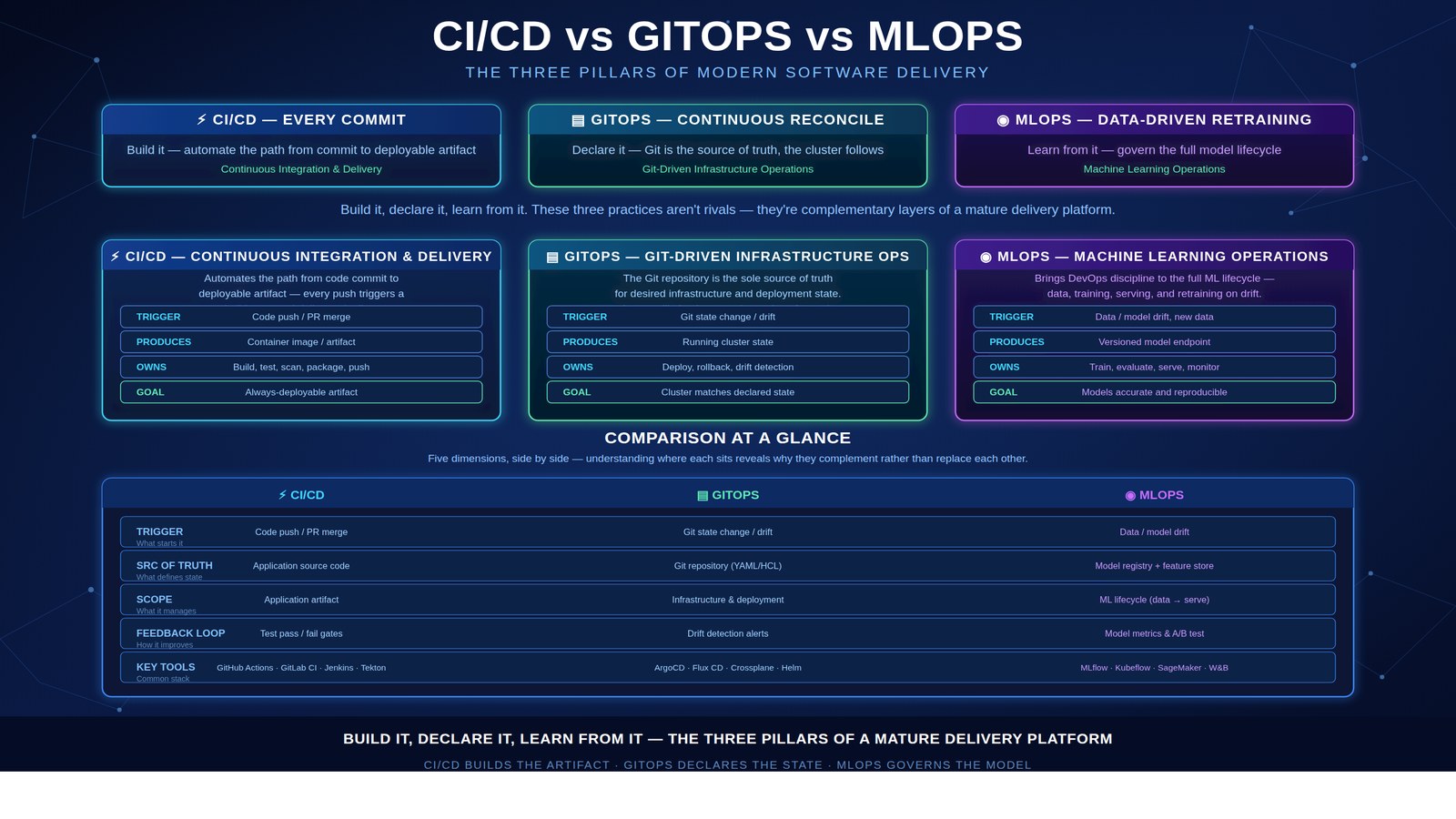
Build it, declare it, learn from it. These three practices aren't rivals — they're complementary layers of a mature delivery platform. This guide explains how each works, where they overlap, and how to compose them in the right order for your team.
Three Disciplines, One Platform
Each methodology emerged to solve a distinct problem in the software lifecycle — from code commit to production model inference. They are not competing philosophies; they are three different answers to three different questions, and a mature platform needs all three.
Comparison at a Glance
Five dimensions, side by side. Understanding where each practice sits on these axes reveals why they complement rather than replace each other.
| Dimension | ⚡ CI/CD | 🗂️ GitOps | 🧠 MLOps |
|---|---|---|---|
| Trigger — what starts it | Code push / PR merge | Git state change / detected drift | Data / model drift, new data or perf threshold |
| Source of truth — what defines state | Application source code | Git repository, declarative YAML / HCL | Model registry, feature store + experiments |
| Scope — what it manages | Application artifact | Infrastructure & deployment (K8s, cloud, state) | ML lifecycle: data → train → serve → monitor |
| Feedback loop — how it improves | Test pass / fail gates, PR checks, coverage, SAST | Drift detection alerts, reconcile loop, sync status | Model metrics & A/B test, retrain on degradation |
| Key tools — common stack | GitHub Actions · GitLab CI · CircleCI · Jenkins · Tekton · Azure DevOps · Argo Workflows · Buildkite · Drone CI | ArgoCD · Flux CD · Crossplane · Terraform + Git · Kustomize · Helm · Fleet · Config Sync · Rancher Fleet | MLflow · Kubeflow · SageMaker · Vertex AI · W&B · Feast · Seldon · ZenML · BentoML · Evidently AI |
Continuous Integration & Continuous Delivery
The automated highway from developer laptop to production artifact. CI/CD eliminates the "works on my machine" problem at scale.
What CI/CD Actually Does
CI/CD is the automation of everything between git push and a deployable artifact. Continuous Integration means every commit triggers a build and test suite — catching integration regressions the moment they're introduced, not days later during a manual release process.
Continuous Delivery extends this: every passing build is in a deployable state, with a human approval gate as the final step. Continuous Deployment removes that gate entirely, shipping to production automatically on every green build. Most teams target Continuous Delivery and selectively enable Continuous Deployment for low-risk services.
Typical Pipeline Stages
- Source CheckoutClone repo, restore dependency cache
- Lint & Static AnalysisCode quality, SAST security scan
- Unit & Integration TestsCoverage gate, mutation testing
- Container BuildOCI image, SBOM generation
- Image Scan (CVE)Trivy / Snyk / Grype vulnerability check
- Push to RegistryTagged, signed image — GitOps picks it up
GitOps: Declaring What You Want, Not What To Do
GitOps flips the deployment model from push-based commands to a pull-based reconciliation loop that continuously enforces declared state.
The Declarative Paradigm Shift
Traditional deployments are imperative: run this kubectl apply, run this Helm upgrade. GitOps is declarative: the repository holds what the cluster should look like, and a controller (ArgoCD, Flux) continuously compares desired state to actual state — reconciling any difference automatically.
This model eliminates an entire class of problems: configuration drift (someone SSH'd in and changed something), untracked hotfixes, "who deployed what at 2am?" Every change is a git commit. The audit log is automatic and immutable.
GitOps Reconciliation Loop
- Git Commit (Desired State)Update image tag or YAML in the config repo
- Controller Detects ChangeArgoCD / Flux polls Git every 3–5 min or via webhook
- Diff: Desired vs ActualRenders manifests, computes delta against live cluster
- Apply to ClusterSync changes; alerts on drift if auto-sync disabled
- Health CheckVerify pods healthy, sync status green
- Continuous WatchLoop repeats — drift is caught and auto-healed
MLOps: Shipping Models, Not Just Code
ML systems are not ordinary software. They encode behavior learned from data. When data changes, even perfectly correct code produces wrong answers. MLOps is how you govern that.
Why ML Needs Its Own Ops Discipline
A traditional service is fully specified by its code. An ML model is jointly specified by its training code and its training data. Change the data distribution — a seasonal shift, a new product category, a world event — and the model degrades silently. No test suite catches this; only monitoring does.
MLOps addresses this by treating training as a reproducible pipeline, model versions as first-class artifacts with a registry, and production inference as a monitored service with automatic retraining triggers on detected drift.
ML Lifecycle Pipeline
- Data Ingestion & ValidationSchema checks, statistical drift detection on inputs
- Feature EngineeringFeature store lookup, transform, version & register
- Model TrainingTracked experiment, hyperparameter search, reproducible run
- Evaluation & RegistryMetric gate, bias check, version promotion
- Canary / A/B ServingShadow mode first, then gradual traffic shift
- Production MonitoringDrift alert → retrain trigger → loop restarts
How They Work Together
On a mature platform, CI/CD builds the artifact, GitOps deploys it, and MLOps manages the model endpoint alongside it — composing into a unified delivery system with shared observability feedback.
Intersection Zones
The most powerful platform engineering happens in the overlap — where two or three of these practices combine into something greater than the sum of their parts.
When to Reach for Each
The real question isn't "which one?" — it's "which ones, and in what order?" Start with CI/CD, layer in GitOps when multi-environment complexity hits, add MLOps when you have models degrading in production.
- You're shipping application code more than once a week
- Manual deployments have caused incidents in the last quarter
- Tests exist but aren't consistently run before merging
- Build reproducibility is a recurring topic in postmortems
- You're onboarding a new team and want to establish good habits from day one
- Managing more than two or three environments (dev / staging / prod)
- Infrastructure drift has caused production incidents
- "What's actually running in prod?" is a hard question to answer quickly
- Rolling back a bad deploy takes more than git revert
- Kubernetes is your primary deployment target
- ML models are making real decisions in production
- A model has silently degraded due to data drift
- Reproducing a training run requires calling the person who ran it
- Promoting a model from staging to production takes weeks
- You're running more than three models across different teams
Three Practices, One Direction
CI/CD, GitOps, and MLOps emerged in different eras of software delivery to solve different problems — but the direction each is moving points to the same place: making the path from change to production faster, safer, and more auditable. CI/CD eliminated manual build-and-deploy ceremonies. GitOps eliminated configuration drift and untracked cluster state. MLOps is eliminating the ad-hoc, notebook-to-production ML lifecycle that has plagued data teams for years.
The mature modern platform is not a choice between these three but a layered composition: CI/CD as the artifact production engine, GitOps as the universal deployment mechanism, MLOps as a specialized lifecycle layer for the ML subset of your workloads. The team that gets this composition right ships software, infrastructure, and models with the same confidence, velocity, and audit trail.
The good news is that you don't have to build all three simultaneously. Start with CI/CD — it pays for itself within the first few weeks of adoption. Add GitOps when environment sprawl becomes a problem. Invest seriously in MLOps the moment you have a model degrading silently in production with no systematic plan to address it. The practices are composable, and the order of adoption can match the order in which the pain appears.