Agentic AI Automation for IT Infrastructure: Achieving 70% Auto-Resolution Across Hyper-Cloud
Agentic AI Automation for IT Infrastructure: Achieving 70% Auto-Resolution Across Hyper-Cloud
When deterministic playbooks meet probabilistic reasoning — and both connect to your full observability and ITSM ecosystem via MCP — your infrastructure begins healing itself faster than your on-call team can respond.
Your infrastructure has outgrown human-speed operations
A single checkout flow today might invoke 40 microservices across three clouds, traverse two private data centers, and touch six managed databases before returning a response. When something goes wrong — and it will — your on-call engineer wakes up to a storm of 200 correlated alerts, five monitoring dashboards with conflicting signals, and the dawning realization that the real root cause is buried somewhere in the interaction between all of them.
Traditional runbook automation helped, but it was brittle. Every new failure pattern required a new runbook. Every cloud migration invalidated your playbooks. Alert fatigue grew. Mean time to resolution stubbornly refused to shrink. What the industry needed wasn't better runbooks — it needed an AI that could reason over infrastructure state and act on that reasoning autonomously.
Agentic AI automation is that answer. By combining deterministic rule execution with probabilistic LLM reasoning — and connecting both to your entire tool ecosystem via the Model Context Protocol (MCP) — organizations are now achieving up to 70% fully automated incident resolution, cutting MTTR by 60%, and detecting failures before they reach end users.
Two kinds of intelligence: deterministic and probabilistic
Agentic AI automation is not a single algorithm. It is a purposeful combination of two execution philosophies — each deployed where it performs best, and together covering the full spectrum of IT incidents.
Deterministic automation
Rule-based, policy-driven execution. A defined condition triggers a specific action — immediately, predictably, and with full auditability. No inference, no ambiguity, no model-reasoning latency. When a pod enters CrashLoopBackOff, it restarts. When disk crosses 90%, logs get purged. When CPU spikes for three consecutive minutes, the autoscaler fires. This mode covers the known, repeatable failure patterns that have proven remediations.
Probabilistic AI engine
LLM-powered reasoning for ambiguous, novel, and multi-system failures that no predefined rule can anticipate. The AI correlates signals across observability tools, generates and ranks root-cause hypotheses, selects the most contextually appropriate runbook, and adapts its actions as the incident evolves — even for failures it has never seen before.
In production, deterministic rules resolve roughly 30–40% of all incidents instantly. The probabilistic AI handles the rest: correlated cascades, novel failures, and the deeply complex "why is checkout slow when every upstream dependency shows healthy?" problems that require genuine causal reasoning across systems. Together they compound toward the 70% target — and critically, every AI-resolved incident feeds back into the deterministic layer, continuously expanding known-good coverage.
The five-layer automation stack
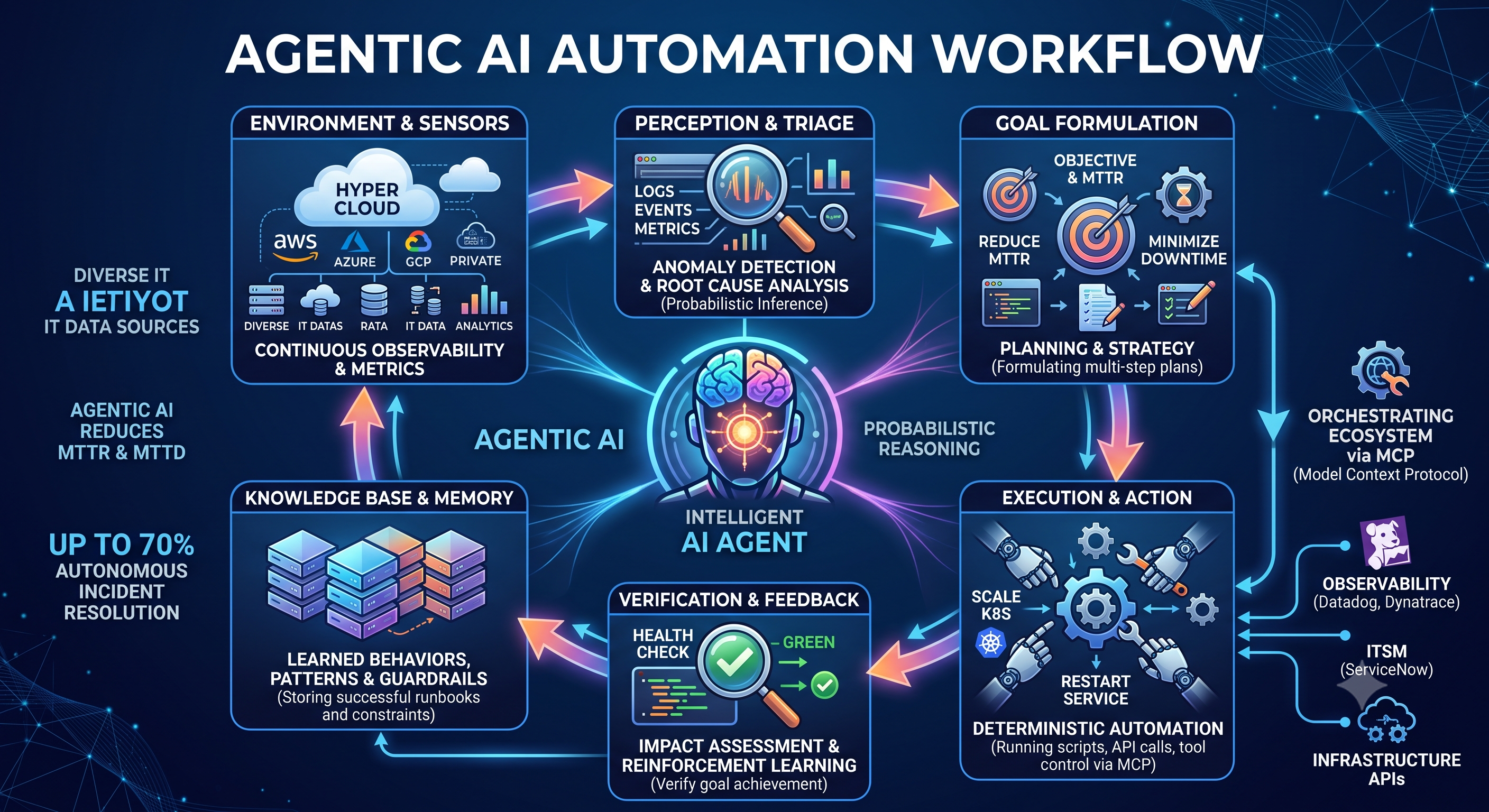
The architecture maps cleanly to a five-layer signal-to-resolution pipeline. Telemetry flows up from cloud sources through a unified observability layer. The MCP integration bus connects the AI engine to every relevant tool in real time. The agentic engine then orchestrates resolution actions downstream — closing the loop from detection to remediation without human intervention.
Figure 1 — The five-layer agentic AI automation stack: from cloud telemetry to autonomous resolution
The MCP integration bus deserves special attention. Rather than custom point-to-point connectors between every tool pair — which historically produced thousands of fragile integrations — MCP standardizes how the AI engine requests and receives context. In a single reasoning cycle, the engine might query Datadog for current SLO burn rates, retrieve the last five change requests from ServiceNow, check Prometheus for historical baselines, and invoke a Jenkins runbook — without leaving the reasoning context. This tight, low-latency tool loop is what makes autonomous resolution practical at enterprise scale.
One engine, every cloud
The agentic AI engine operates uniformly across the full hyper-cloud estate. Each provider exposes different APIs, different alert formats, and different resource models — but the MCP abstraction layer normalizes these differences so the AI reasons over a unified infrastructure representation.
Private cloud
VMware vSphere, OpenStack, and bare-metal clusters. The engine handles VM failures, host maintenance windows, storage path faults, and network fabric issues using on-premise telemetry and your internal CMDB as context sources.
Amazon Web Services
ECS and EKS failures, Lambda cold-start regressions, RDS performance anomalies, S3 replication lag, and CloudWatch alarm storms. Native AWS CloudWatch MCP integration provides real-time cost and performance context during reasoning.
Microsoft Azure
AKS cluster health, Azure Monitor alerts, App Service availability incidents, Azure SQL DTU breaches, and Service Bus queue depth spikes. ARM template history informs change-correlated root cause analysis automatically.
Google Cloud Platform
GKE workload disruptions, Cloud Run autoscaling failures, BigQuery job latency spikes, Pub/Sub consumer lag, and Cloud Monitoring alert policies. GCP's Ops suite feeds directly into the unified observability layer.
One protocol, every tool
The Model Context Protocol (MCP) is the integration layer that makes agentic automation practical at enterprise scale. Instead of custom connectors for each tool pair, MCP exposes standardized read and write interfaces that the AI engine calls in real time during its reasoning cycle. The breadth of tool coverage is what enables high-fidelity RCA — a narrow integration set produces narrow answers.
Observability & monitoring
ITSM & incident management
Each MCP server exposes fine-grained capabilities that the AI engine calls during reasoning. The ServiceNow MCP alone can query incident history, retrieve recent change requests by CI, check CMDB relationship maps, create new incidents with pre-populated RCA context, and propose change advisory board items — all within a single 30-second reasoning pass. The AI becomes a peer inside your operations toolchain, not a separate system that needs to be translated between.
From static playbooks to dynamic, self-improving runbooks
Traditional runbook automation treats runbooks as static documents — someone writes them, they get linked to an alert, and they run verbatim until they break. Agentic AI fundamentally changes this model at every stage of the runbook lifecycle.
When the AI engine detects an incident, it doesn't just look up a matching runbook by keyword. It evaluates current incident state against its full runbook library, selects the most contextually appropriate playbook, dynamically parameterizes the execution against the affected environment, and monitors each step — automatically rolling back and attempting an alternative path if an action makes things worse. After resolution, the engine proposes runbook patches based on observed execution gaps and logs them as change requests for human review.
MTTR impact: before and after agentic automation
10–15 min: acknowledge and triage
30–90 min: root cause identification
15–30 min: manual remediation execution
<30 sec: detection and triage
2–5 min: probabilistic RCA
1–3 min: automated runbook execution
For the 30–40% of incidents that match deterministic patterns, MTTR effectively drops to zero from a human perspective: the rule fires, the action executes, and the ticket closes — all before an engineer would have received the page. The cumulative effect across an organization running thousands of services is substantial: tens of thousands of engineer-hours recovered annually, redirected from reactive firefighting to proactive reliability work.
Root cause analysis in minutes, not hours
The probabilistic AI engine approaches root cause analysis the way an expert SRE would — by simultaneously considering telemetry signals, recent changes, service dependency graphs, and historical incident patterns. But it does this at machine speed, with perfect recall of every relevant data point across your entire tool estate, and without the context-switching cost of a human moving between five monitoring dashboards.
A typical AI-driven RCA cycle looks like this: the engine receives an alert, immediately queries its MCP-connected tool network to gather context — current metrics, recent deployments, change history, similar past incidents — forms a ranked set of competing hypotheses, and then either acts autonomously on the highest-confidence hypothesis or surfaces a structured analysis card to the on-call engineer with evidence, confidence scores, and a pre-staged remediation plan.
- ✓ Cross-service causality. The AI traces failure propagation across service boundaries and cloud providers — identifying that a Redis lock contention caused by a misconfigured connection pool released in the last deployment is the root cause of today's checkout timeout, even when the symptoms appear in a completely separate service.
- ✓ Change-correlated analysis. Every RCA query automatically checks recent change records in ServiceNow or Jira. If a deployment, configuration change, or infrastructure modification occurred within the incident window, it surfaces as a candidate cause with supporting evidence before any other hypothesis is evaluated.
- ✓ Historical pattern matching. The AI maintains a vectorized incident memory. New incidents are semantically compared against historical resolutions, and proven remediation patterns are promoted to deterministic rules — continuously shrinking the probabilistic resolution space and raising the automation floor.
- ✓ Confidence-gated autonomy. The engine acts autonomously when RCA confidence exceeds a configurable threshold. Below that threshold, it pages the on-call engineer with a structured hypothesis deck pre-attached to the incident ticket — reducing triage time by up to 80% even in human-in-the-loop mode.
- ✓ Proactive detection. By continuously analyzing telemetry trends against learned baselines, the AI identifies impending failures 15–30 minutes before they become customer-impacting incidents — triggering preventive runbooks that eliminate the incident before it requires a response at all.
The path to 70% automated resolution
Reaching 70% automated resolution is not a single deployment — it is a phased capability build. Organizations that have achieved this target typically follow a three-phase journey over 12–18 months, progressively raising the AI's autonomy as its track record and confidence earn trust.
What fully deployed organizations are achieving
- ✓MTTD reduced by ~45% through continuous anomaly analysis and predictive alerting before symptoms become customer-visible
- ✓MTTR reduced by ~60% across all severity levels; effectively near-zero for incidents matching deterministic patterns
- ✓On-call engineer wake-up rate drops by 65%+ — only genuinely novel or high-stakes incidents that require human judgment reach the on-call rotation
- ✓Runbook library accuracy improves 15–20% per quarter as the AI continuously identifies stale steps, patches failure modes, and proposes new coverage
- ✓Cross-cloud incident correlation latency drops from hours to minutes, with structured RCA summaries auto-attached to every incident ticket in ServiceNow or Jira
- ✓Infrastructure costs decrease as autonomous right-sizing, idle resource cleanup, and proactive scaling prevent over-provisioning and emergency capacity purchases
The autonomous operations era has arrived
The combination of deterministic rules, probabilistic AI reasoning, and deep tool integration via MCP represents a fundamental shift in IT infrastructure operations. This is not incremental improvement to existing runbook automation — it is a new operational model where the infrastructure is an active participant in its own recovery, and where the AI's institutional knowledge compounds every week it operates.
The 70% automated resolution figure is a milestone, not a ceiling. Organizations that invest in the continuous improvement loop — where every AI-resolved incident improves future performance — report automation rates continuing to grow quarter over quarter as the system's understanding deepens. The 80% horizon is achievable within 24 months for organizations with mature telemetry instrumentation and well-connected ITSM toolchains.
For IT leaders navigating the compounding complexity of hyper-cloud environments, the question is no longer whether to adopt agentic AI automation, but how quickly to build the integration fabric — the observability connections, the ITSM handshakes, the runbook libraries — that this class of AI requires to perform at its best. The infrastructure is ready. The tools are connected. The AI is capable. The gap between where your MTTR is today and where it could be is, at its core, an implementation gap.