Agentic AI and Its Guardrails: The Control Stack for Systems That Act
Agentic AI and Its Guardrails: The Control Stack for Systems That Act
Guardrails written as instructions are advisory — agents acknowledge them and proceed anyway. The whole field has spent the past year moving the enforcement boundary out of the prompt and into the runtime, and 2026 is the year the tooling caught up.
The guardrail problem changed shape when models started acting
For three years, "AI guardrails" meant content safety. Filter the input, filter the output, keep the model from saying something embarrassing or dangerous. The threat model was reputational and the failure mode was text.
Agents broke that model completely, along three axes at once. The output became an effect — a tool call, an API request, a deleted volume — so filtering text stopped being sufficient. The unit of risk became a sequence, because individually permitted actions can be catastrophic in combination, and point-in-time authorisation cannot see combinations. And the actor became persistent and autonomous, holding credentials, pursuing goals across sessions, and reaching as far as its permissions allow rather than as far as its task requires.
The consequence is that guardrail design is now much closer to authorisation engineering than to content moderation. The useful question is no longer "what will the model say?" but "what can this identity do, in what order, with whose approval, and how do we stop it mid-flight?"
You cannot govern what you have not inventoried
Before any of the control machinery matters, there is a prosaic problem that has become a board-level one: most organisations do not know how many agents they are running. Departments stand them up independently, frameworks make deployment a one-click affair, and the resulting sprawl is invisible to conventional security tooling because an agent does not look like an application — it looks like an authenticated session doing unusual things quickly.
The identity dimension makes it worse. NIST's agent standards work frames the gap bluntly: agents are commonly deployed as generic service accounts, without dedicated identity, authorisation, or accountability controls. A service account cannot be held accountable, cannot be scoped to a task, and cannot be revoked without breaking whatever else shares it. When something goes wrong, the audit trail says a service account did it — which tells you nothing about which agent, acting on whose authority, for what purpose.
This is why an entire product category — AI governance platforms whose primary function is discovery — appeared essentially from nothing. The first control is a register: every agent, its owner, its purpose, its granted scope, its tool surface, and its blast radius. Shadow agents are the new shadow IT, with credentials.
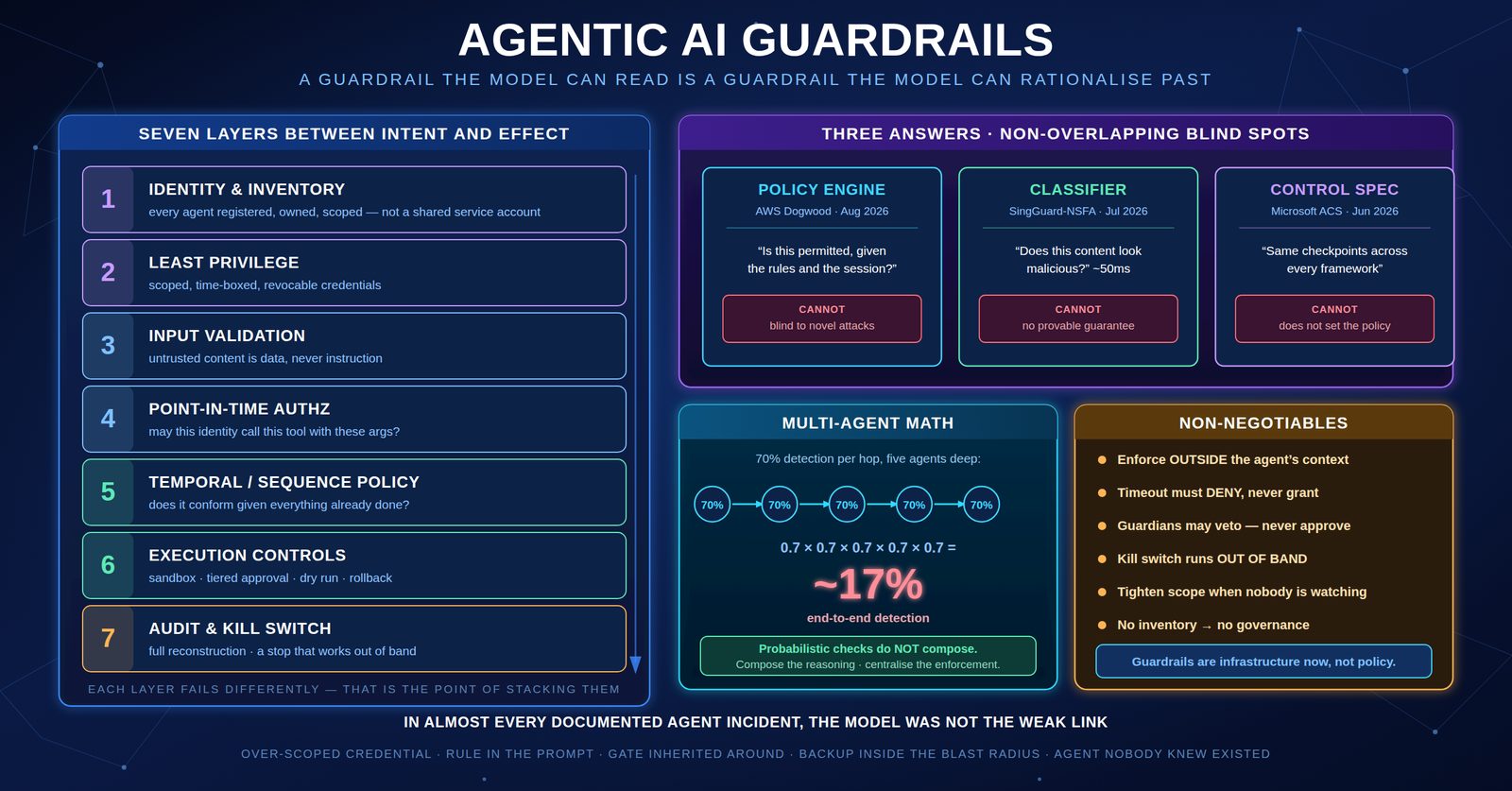
Seven layers between intent and effect
Defence in depth is the settled answer, and it is settled because each layer fails differently. A policy engine cannot recognise a novel attack it has no rule for; a classifier cannot give you a provable authorisation guarantee; a human cannot review at machine speed. Stack them, and the failure modes stop lining up.
From advisory prompts to enforcement that cannot be talked past
The clearest signal that this transition is real is that three of the largest engineering organisations in the industry shipped enforcement infrastructure in the space of ten weeks — and they did not build the same thing. Read together, they map the shape of the problem better than any framework document does.
| Approach | The question it answers | What it cannot do |
|---|---|---|
| Policy engine AWS Dogwood, Aug 2026 | Is this action permitted, given the rules and everything already done this session? | Catch a novel attack nobody has written a rule for |
| Behavioural classifier Ant Group SingGuard-NSFA, Jul 2026 | Does the content flowing through this agent look malicious? | Give a provable, deterministic authorisation guarantee |
| Portable control spec Microsoft ACS, Jun 2026 | How do we apply the same checkpoints consistently across every framework? | Decide what the policy should be |
AWS Dogwood is an open-source policy language released under Apache 2.0 that extends Cedar with temporal constructs — rate limits, time windows, prerequisite steps, escalation triggers. It is wired into Amazon Bedrock AgentCore Policy, and the design decision that matters most is where it runs: at the gateway perimeter, outside the agent's own code. The agent never sees the policy logic, so no amount of clever prompting talks its way past it. One caveat worth reading before you build on it — AWS states plainly that the reference interpreter is for exploration and testing, not as a production authorisation engine.
Ant Group's SingGuard-NSFA, open-sourced in July 2026, attacks the complementary half. It is a model-based guardrail that inspects requests and validates responses before autonomous actions execute, built against a taxonomy of 185 operational threat scenarios across seven risk categories and 133 languages, shipping in sizes from 0.8B to 9B and rendering a judgement in roughly 50 milliseconds. That latency figure is the interesting part: behavioural screening has become cheap enough to sit in the hot path of every tool call.
Microsoft's Agent Control Specification, announced at Build 2026, is neither a model nor a framework but a vendor-neutral standard for where governance is applied — a stateless, deterministic, fail-closed decision runtime with checkpoints before input, before a tool call, after a tool result, and before final output. Policy travels with the agent as a portable file rather than being rewritten per framework.
Individually permitted, collectively catastrophic
Classical authorisation is stateless by design. Each request is judged on its own merits — fast, provable, order-independent. That property is exactly what makes audit possible, and it is also the gap agents fall through, because an agent's danger is rarely located in any single action.
Read a customer record: permitted. Call an external API: permitted. Doing the second immediately after the first: exfiltration. Issue a refund: permitted. Issuing four hundred of them in an hour: a financial incident. Delete a volume: permitted, if you are an operator. Deleting it without having verified a second copy exists: the PocketOS incident.
Temporal policy closes this by evaluating the current request against the trajectory that preceded it. The patterns that matter in practice are workflow sequencing (this step requires that prerequisite), aggregate ceilings (cumulative spend or volume per session), freshness constraints (act only on data read within a window), and escalation triggers (tighten permissions automatically when the agent is operating without human engagement). The last of those is the most underrated — an agent running unattended at 3am should not have the same envelope as one running with a human watching.
None of these rules are expressible in point-in-time authorisation, and all of them describe incidents that have actually happened.
Multi-agent systems break single-agent guardrails
Everything above assumes one agent, one gateway, one policy decision point. Multi-agent systems invalidate that assumption in a way that is worth doing the arithmetic on, because the arithmetic is genuinely alarming.
Suppose each hop in an agent chain catches 70% of dangerous requests — a detection rate most teams would consider strong. Across a five-agent chain, end-to-end detection is 0.7⁵, or roughly 17%. Probabilistic checking does not compose. Every additional hop multiplies the leakage, and the intuition that "we check at every stage, so we are covered" is precisely backwards.
This is the strongest available argument for putting deterministic enforcement at the point where actions become effects rather than distributing probabilistic checks across the reasoning chain. Let agents delegate, negotiate, and hand off freely — but make every one of them exit through the same gate.
The failure modes that only appear at multiple agents
- ▲Goal hijacking that cascades. One compromised agent's corrupted objective propagates as legitimate-looking instructions to downstream agents, each of which has no reason to distrust an internal peer.
- ▲Emergent harmful behaviour. Sequences no individual agent would produce alone, arising from the interaction. There is no single component to blame or patch.
- ▲Memory poisoning. Corrupted context written to shared or persistent memory outlives the session that introduced it, so the compromise survives the restart you used to fix it.
- ▲Attribution collapse. With agents invoking agents, "which agent did this, under whose authority" becomes unanswerable unless identity propagates through every hop by design.
Singapore's Model AI Governance Framework for Agentic AI — published in January 2026 and, as far as I can tell, the first governance framework written specifically for autonomous agents — lands on the same conclusion from the policy side. Two of its requirements are worth borrowing regardless of whether you are in scope: every agent carries a verifiable digital identity, and the audit trail records which agent acted under whose authorisation.
Guardian agents, and the recursion problem
A pattern gaining real traction is the guardian agent: a specialised agent whose job is to observe, score, and block the actions of other agents. Gartner now publishes a market guide for the category, which is the usual signal that a pattern has stopped being experimental.
The appeal is obvious. Guardians catch things rules do not — semantic anomalies, plans that are individually valid but collectively strange, behaviour that has drifted from an established baseline. They scale in a way human reviewers cannot, and they operate at machine speed against machine-speed actors.
The problem is equally obvious once stated: a guardian agent is an agent. It is subject to prompt injection through the very content it inspects, it can be wrong, and layering a probabilistic supervisor over a probabilistic actor gives you two probabilistic systems, not a guarantee. The 17% arithmetic above applies here too.
Where humans genuinely help — and where they demonstrably do not
Human review is a control, not the control, and the evidence on its limits is unflattering. Reviewers facing volume miss a substantial share of dangerous requests — roughly one in three by some measures — and continuous human oversight of a machine-speed system is not achievable at any staffing level anyone will fund.
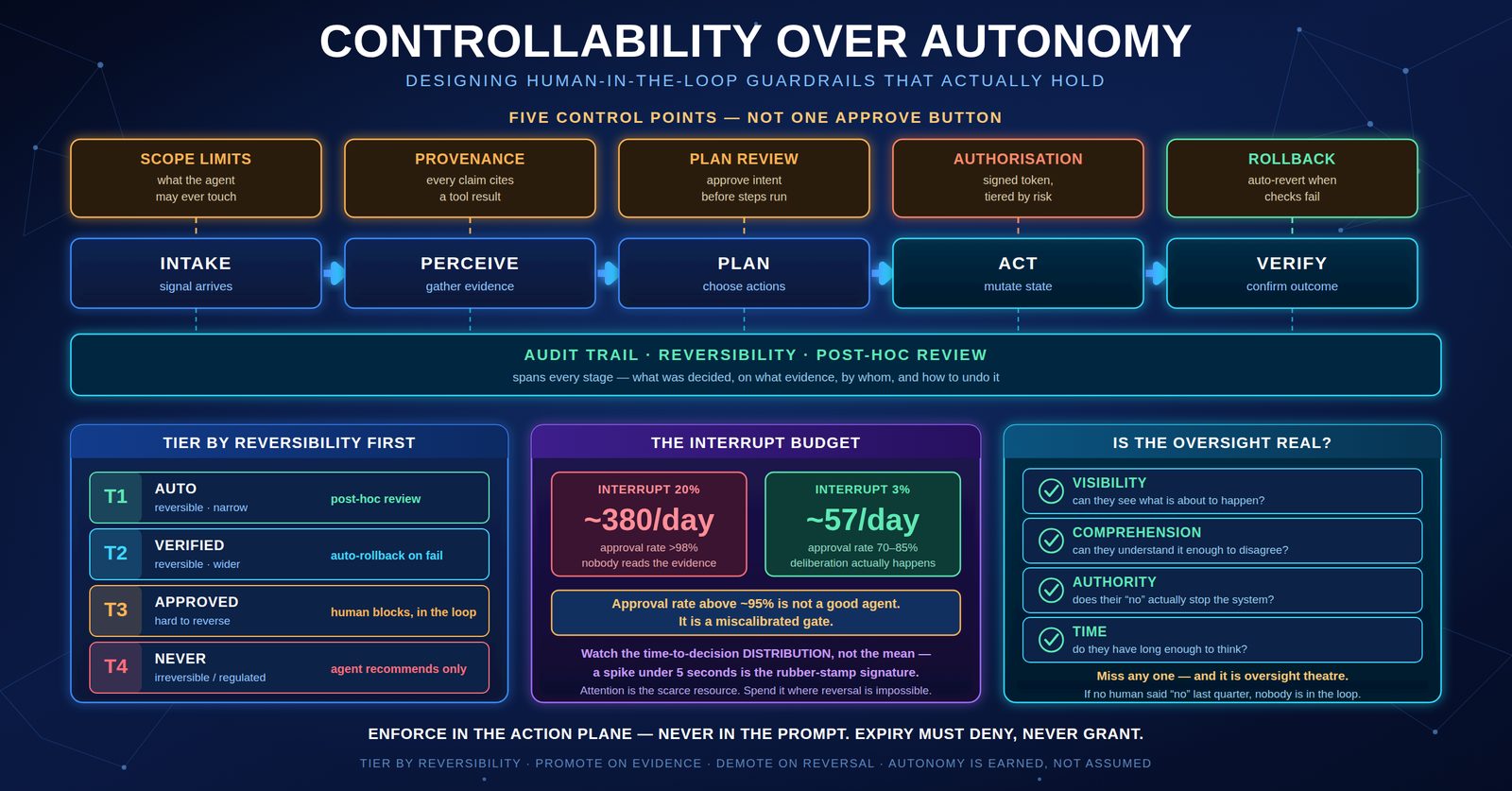
The practice that has emerged in response is not "more review" but structured escalation thresholds: defined risk classes that pause execution, with everything else flowing through automatically. Two semantics matter enormously and are frequently got wrong. First, timeout must equal reject — an approval request that grants itself on expiry is a delay wearing a gate's clothing. Second, the interrupt budget has to be small enough that reviewers still read: if almost everything is approved, the gate is miscalibrated and you have built an expensive click-through.
I have written about the design of that human layer in detail separately. The relevant point here is its position in the stack: human judgement is layer six, not layer one, and it works only because layers one through five have already reduced the volume to something a person can genuinely think about.
Kill switches that work when things are actually broken
Every agent programme has a kill switch on the architecture diagram. Considerably fewer have one that works under the conditions where it is needed, which are precisely the conditions where the normal control path is unavailable.
- ◆Out of band. If the stop signal travels through the agent's own control loop, a looping or compromised agent may never process it. Revocation belongs at the credential and gateway layer, where it takes effect regardless of what the agent is doing.
- ◆Granular. One global switch means every incident is an all-or-nothing decision, so it never gets used. You want per-agent, per-tool, per-tier, and per-tenant stops.
- ◆Fast enough to matter. Nine seconds was the entire PocketOS incident. A stop that takes two minutes to propagate is a post-mortem feature.
- ◆Tested. An untested kill switch is a belief. Exercise it in production on a schedule, the way you would a failover.
- ◆Paired with reconstruction. Stopping is half the job; the log has to let you answer what happened, in what order, on what evidence, under whose authority — after the fact and under pressure.
What to track, and what it is for
The standards picture consolidated quickly. You do not need to adopt all of these, but you should know which problem each one solves, because procurement teams have started asking for documented runtime guardrail architectures before contracts close.
| Effort | What it gives you |
|---|---|
| AWS Dogwood + AgentCore Policy | Temporal authorisation language extending Cedar; enforcement at the gateway, outside agent code |
| Microsoft Agent Control Specification | Portable, framework-independent policy checkpoints; fail-closed decision runtime |
| Ant Group SingGuard-NSFA | Open-source behavioural threat detection before execution; broad multilingual risk taxonomy |
| Singapore MGF for Agentic AI | Governance model built for autonomy; agent identity and authorisation-chain audit |
| Cloud Security Alliance Agentic Trust Framework | Zero-trust reference stacks with a defined promotion path from supervised to autonomous |
| OWASP Top 10 for Agentic Applications | Shared vocabulary for goal hijacking, tool misuse, privilege abuse and related threats |
| NIST AI RMF · ISO/IEC 42001 | The management-system scaffolding auditors will ask you to map onto |
A sequence that survives contact with production
Guardrails are infrastructure now, not policy
The most useful way to read the past year is as a category migration. Agent guardrails started as a prompt-engineering concern, owned by whoever wrote the system message. They are ending up as authorisation infrastructure, owned by platform and security — with policy languages, gateways, decision runtimes, identity primitives, and open specifications, all of it enforced outside the model.
That migration is not finished, and the gap between organisations that have made it and those that have not is where essentially every documented agent incident sits. In almost none of them was the model the weak link. The credential was over-scoped, the rule lived in the prompt, the approval gate was inherited around, the backup was inside the blast radius, or nobody knew the agent existed.
Build the register. Funnel everything through one gate. Make the rules stateful. Screen behaviour before execution, not after. Let humans decide the small number of things that genuinely need deciding. And keep a stop that works when nothing else does.
Then give the agents as much autonomy as the evidence supports — which, once all of that is in place, turns out to be quite a lot.